- Home
- State laws
- California
- Breaking a lease
Breaking a lease in California
Checked against the California statutes on October 1, 2026 General information, not legal advice
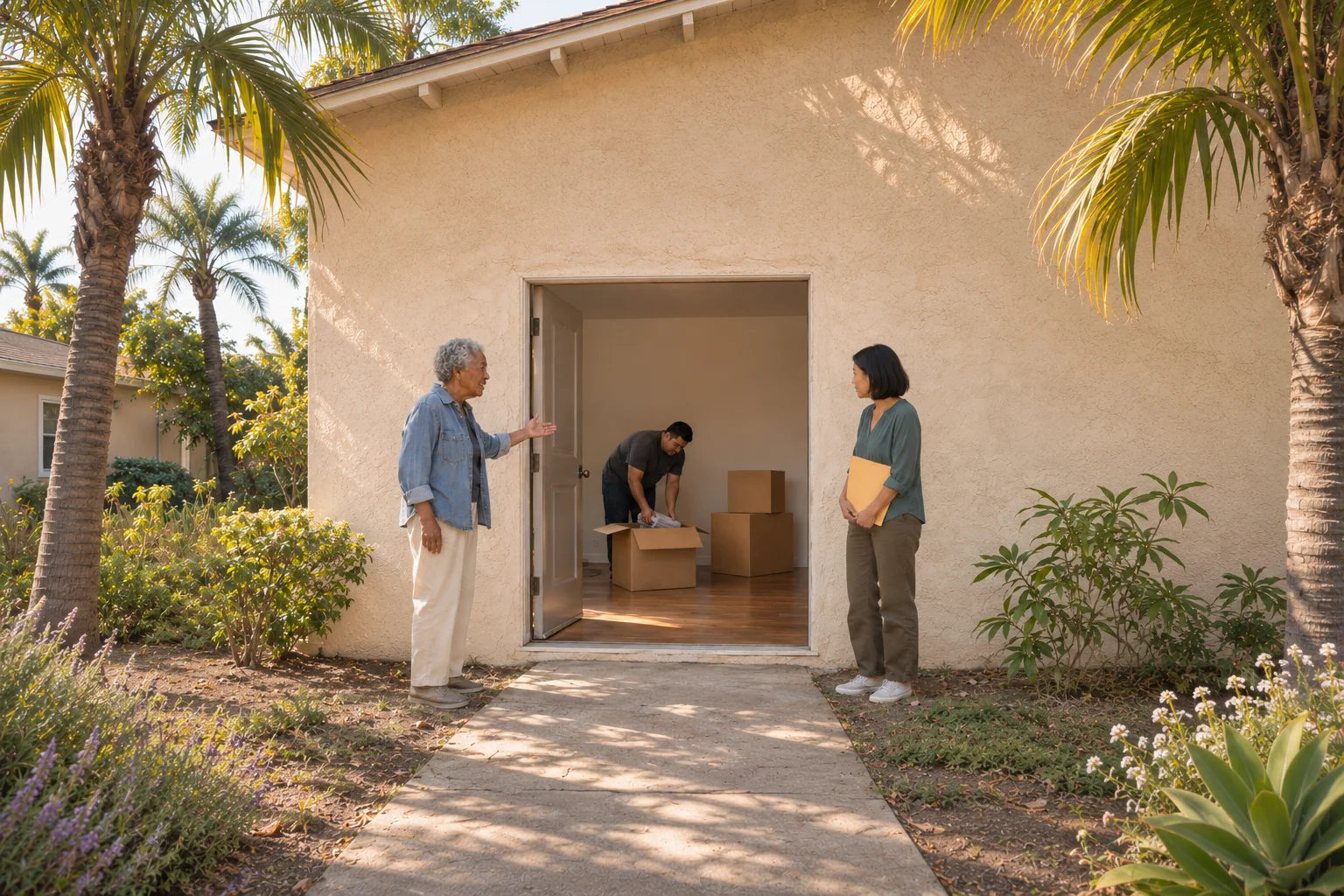
- Show the unit to new renters
- The tenant can still move out
- A new lease can end the old one
Key numbers
- Owner ending a month-to-month tenancy
- 60 or 30 days
- 30 days if any tenant or resident has lived there less than a year; just cause may also be needed
- Cal. Civ. Code § 1946.1(b), (c)
- Deposit refund deadline
- 21 days
- calendar days after the tenant moves out, with an itemized statement
- Cal. Civ. Code § 1950.5(h)(1)
Ending a fixed-term lease early
Partly readIf a tenant breaks the lease and leaves early, you can recover the rent for the rest of the term only to the extent the tenant cannot prove the loss could reasonably have been avoided, so you are expected to try to re-rent (Cal. Civ. Code § 1951.2(a)).
- A tenant may end the tenancy with written notice and supporting documentation if the tenant, a household member or an immediate family member was the victim of an act or crime listed in 1946.7. The section allows notice within 180 days of the qualifying order, report or act, or within the notice period described in 1946. The rent obligation is no more than 14 calendar days after notice, or an appropriate shorter period under 1946 or the rental agreement (Cal. Civ. Code § 1946.7(a), (d), (e)).
- The written notice may attach a qualifying protective order, a law-enforcement report, documentation from a qualified third party using the statutory statement, or other documentation that reasonably verifies the listed act or crime. A police report is not the only option. Information provided under this section may be disclosed only with the tenant's written consent or when law or a court order requires it; checking the contents with the qualified third party is allowed (Cal. Civ. Code section 1946.7(b), (i)).
- For a qualifying termination, rent is prorated if the home is relet before the tenant's remaining rent obligation ends. The landlord may not require forfeiture of a deposit or advance rent because of the termination, and the termination itself is not a lease breach. Other deposit rules still apply (Cal. Civ. Code section 1946.7(e), (f)).
- The release covers the qualifying tenant and members of that tenant's household; it does not automatically release every other tenant who signed the lease. A household member here means a family member living in the same unit. If the qualifying immediate family member lived elsewhere and no part of the act or crime occurred in or within 1,000 feet of the tenant's home, the notice also needs the written relocation statement required by subsection (c) (Cal. Civ. Code section 1946.7(c), (g), (h)).
The lease lets a tenant end the tenancy under the victim of abuse or violent crime section, commits the landlord to try to re-rent after an early move-out, and includes a federal service member termination clause.
Tenant repair remedies
If you do not repair conditions making the home untenantable within a reasonable time after written or oral notice, the tenant may make the repair and deduct the cost from rent, up to one month's rent, or may move out and stop owing rent. The tenant may use this remedy no more than twice in any 12 months (Cal. Civ. Code § 1942(a)).
- A tenant who repairs after the 30th day following notice is presumed to have waited a reasonable time; a shorter wait can be reasonable if the circumstances require it (Cal. Civ. Code § 1942(b)).
- The remedy is not available if the condition was caused by the tenant's breach of the tenant's own duties under the sections it names (Cal. Civ. Code § 1942(c)).
The lease states the repair and deduct remedy, its one month's rent limit and the twice in 12 months limit.
Subletting and assignment
Not set by statuteCalifornia has no statute that sets a general rule on subletting a home; Civil Code 1995.010 and following apply only to leases for other than residential purposes. The lease controls, so state in it whether the tenant needs your written consent (Cal. Civ. Code § 1995.010).
- A tenant who assigns or sublets against the lease ends the lease, and you may then serve a three-day notice to quit on the people in possession (Cal. Code Civ. Proc. § 1161(4)).
- Where the statewide just cause rules apply, assigning or subletting in violation of the lease is an at-fault just cause (Cal. Civ. Code § 1946.2(b)(1)(G)).
- If the lease states the Civil Code 1951.4 remedy and does not bar subletting or assignment, or limits it only by reasonable standards or by consent you may not unreasonably withhold, you may keep the lease in force after the tenant abandons the home and collect rent as it comes due (Cal. Civ. Code § 1951.4).
Ending a month-to-month tenancy
To end a month-to-month tenancy, an owner must give written notice at least 60 days before the termination date, or at least 30 days if any tenant or resident has lived in the unit less than one year. A tenant must give notice at least as long as the rental period, which is 30 days for a monthly tenancy (Cal. Civ. Code § 1946.1(b), (c); Cal. Civ. Code § 1946(a)).
- An owner may give 30 days' notice to sell a separately alienable unit to a natural person who will live there for at least a year, if escrow was opened no more than 120 days before the notice and the other conditions of the section are met (Cal. Civ. Code § 1946.1(d)).
- An owner's notice must include the statutory statement that former tenants may reclaim abandoned personal property, and you may not charge the tenant for serving it (Cal. Civ. Code § 1946.1(h), (i)).
- After 12 months of occupancy, a covered tenancy can end only for a just cause stated in the notice (Cal. Civ. Code § 1946.2(a)).See Just cause to end a tenancy on the California page
The lease gives the tenant a 30-day notice and the landlord a 60-day notice, or 30 days where the tenant has lived there less than a year, and notes the just cause rule.
Returning the deposit
No later than 21 calendar days after the tenant has moved out, give the tenant an itemized statement of the security received and how it was used, and return the rest. You may deduct only what is reasonably necessary for unpaid rent, damage beyond ordinary wear and tear, cleaning back to the condition at move-in, and the other purposes the section allows (Cal. Civ. Code § 1950.5(b), (e), (h)(1)).
- Subject to the multiple-adult-tenant rules, if you received security or rent electronically, return the remainder to the account the tenant designates in writing, or by an available electronic method the tenant agrees to in writing, unless you agree in writing on another return method. Give written notice of this right within a reasonable time after either side's termination notice or before the lease ends, except where a different method was already agreed in writing or the specified CCP1161(2)-(4) termination exception applies. A successor's electronic-return duty depends on receiving rent electronically from that tenant (Cal. Civ. Code § 1950.5(h)(1)(A)(ii)).
- Otherwise use personal delivery or a check mailed first class, postage prepaid. With multiple adult occupants, the default refund check names all adults on the rental agreement when the tenancy ends, and the statement goes to one adult selected by the landlord. An agreement signed by the landlord and every adult tenant may specify recipients, allocation percentages, payment method and each adult's statement delivery/address. Section1950.5(h)(1)(C)(iii) separately permits another disbursement on a qualifying1946.7 terminating tenant's request where no such mutual agreement exists (Cal. Civ. Code § 1950.5(h)(1)(A)(i), (C)).
- With the statement, include copies of documents for repair and cleaning charges: for your own or your employee's work, a description with the time spent and the hourly rate; for anyone else's work and for materials, the bill, invoice or receipt; plus the photographs of the unit. You may skip this when repair and cleaning deductions together are $125 or less, unless the tenant asks for the documents within 14 calendar days after receiving the statement. A timely tenant request requires compliance within 14 calendar days after receipt. A documentation waiver has specific timing, signature and text conditions; it does not remove a later timely request right (Cal. Civ. Code § 1950.5(h)(2), (h)(4), (h)(5)).
- You may not deduct for damage or defects that existed before the tenancy or for ordinary wear and tear (Cal. Civ. Code § 1950.5(e)(2)).
- A landlord who in bad faith fails to comply with these return duties may not claim any of the security, and bad faith retention can bring statutory damages of up to twice the amount of the security on top of actual damages (Cal. Civ. Code § 1950.5(h)(7), (m)).
- A good-faith estimate is available when a repair cannot reasonably be completed within 21 calendar days or supporting third-party documents have not arrived. State the estimate in the timely itemization and identify the outside provider when documents are missing. Complete the required accounting and documents within 14 calendar days after completing the repair or receiving the documentation; the estimate does not cancel the original closeout deadline (Cal. Civ. Code § 1950.5(h)(3)-(5)).
- Preserve the starting condition, resident comments, dated photographs, actual work and reasonable charge calculation. Professional cleaning must be reasonably necessary to restore the initial condition, excluding ordinary wear. A lease fee label, blanket carpet-cleaning charge or replacement invoice alone does not establish that the resident owes it. Give a disputed item its own factual review; damages above the deposit still require a lawful basis and proof (Cal. Civ. Code § 1950.5(b), (e)(2), (m)).
- Send the itemized statement by personal delivery or prepaid first-class mail unless the permitted agreement changes delivery; email requires mutual agreement and an account supplied by the tenant. Check the multiple-adult rules separately. For required mailings, use the tenant's supplied address, or the vacated unit if none was supplied. Keep a delivery and refund record rather than treating a generated statement as completed delivery (Cal. Civ. Code § 1950.5(h)(1)(B)-(C), (h)(6)).
The lease repeats the 21 calendar day deadline, the itemized statement, the photographs, the $125 documentation threshold, the ban on wear and tear deductions and the loss of the claim for a bad faith failure, and it promises electronic return where the tenant paid electronically.
Options short of breaking the lease
When a tenant asks to leave early without one of the reasons above, these are the usual ways to settle it. Put whatever you agree in writing, signed by every tenant on the lease.
Steps for an early move-out
- Read the lease
Find the early termination clause, the notice terms and the subletting rule.
- Match the reason
If the tenant gives a legal reason, check it against the California rule above and ask only for the documents that rule names.
- Confirm in writing
Record the end date, the final rent and any fee, and keep proof of delivery.
- Close out the tenancy
Inspect and photograph the home, try to re-rent where the rules above require it, and return or itemize the deposit by the deadline.
Legal help in California
Questions
How do I end a month-to-month tenancy?
Give written notice at least 60 days ahead, or 30 days if any tenant or resident has lived there less than a year, including the statutory statement about reclaiming abandoned property. If a tenant has lived there 12 months and the home is covered by the statewide just cause rule, you also need a just cause stated in the notice (Cal. Civ. Code § 1946.1(b), (c), (h); Cal. Civ. Code § 1946.2(a)).
Do I need just cause to end a tenancy?
For covered housing, yes, once the tenants have lived there 12 months (or 24 months for one tenant where an adult was added earlier). A curable violation needs a notice to cure first, and a no-fault ending needs one month's rent in relocation help or a written waiver of the last month's rent. A notice that does not comply is void (Cal. Civ. Code § 1946.2(a), (c), (d), (g)).