- Home
- State laws
- New York
- Breaking a lease
Breaking a lease in New York
Checked against the New York statutes on October 1, 2026 General information, not legal advice
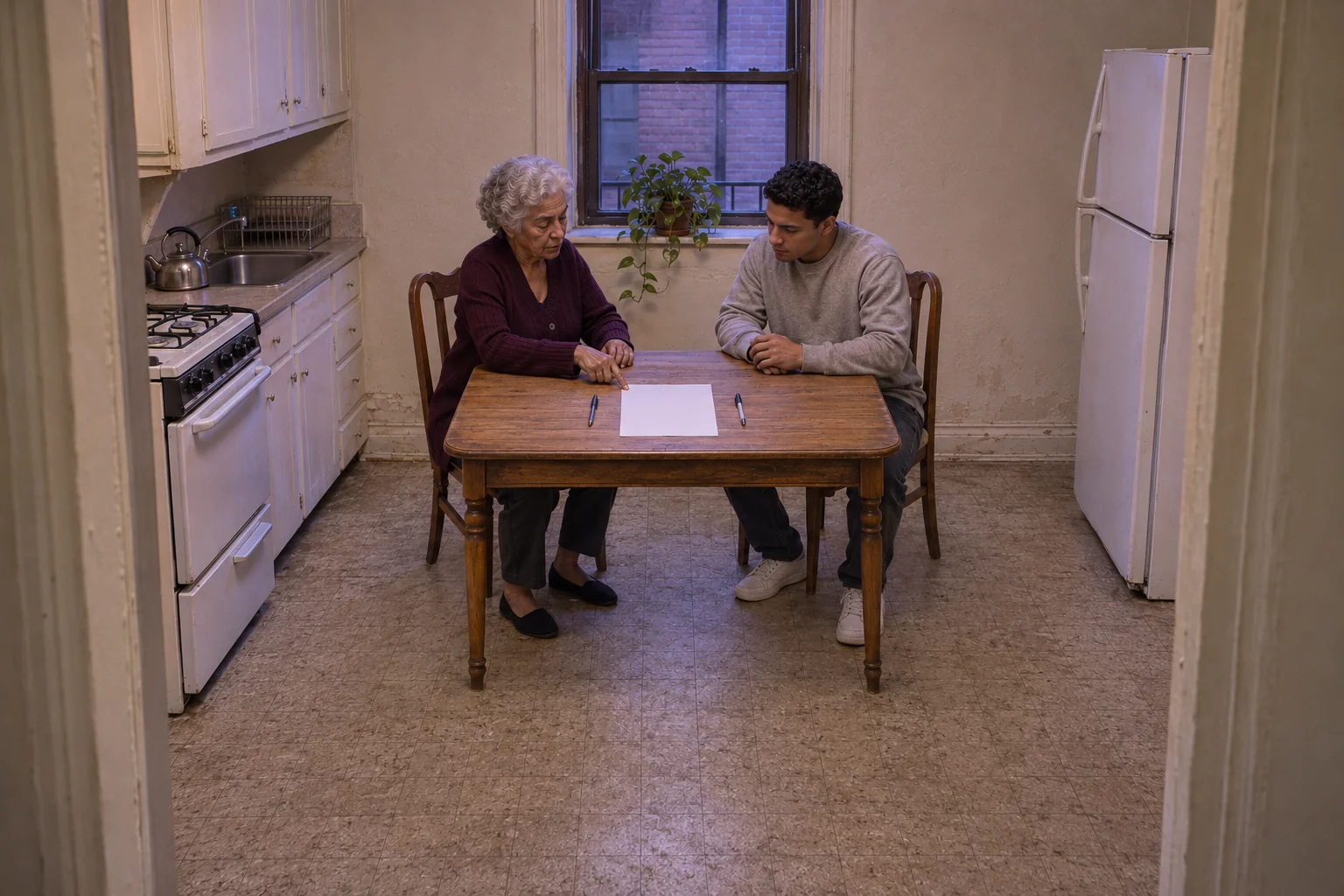
- Put the agreement in writing
- Both sign the release
- Talk it through early
Key numbers
- Ending a month-to-month tenancy
- 30, 60 or 90 days
- landlord notice, by length of occupancy or lease term
- N.Y. Real Prop. Law § 226-c(2)N.Y. Real Prop. Law § 232-a
- Deposit refund deadline
- 14 days
- after the tenant vacates, with an itemized statement
- N.Y. Gen. Oblig. Law § 7-108(1-a)(e)
Ending a lease early
A tenant who leaves early in breach of the lease can still owe you, but you must in good faith take reasonable and customary steps to re-rent the home at fair market value or the lease rate, whichever is lower. A new tenant's lease ends the old one and reduces what the departing tenant owes, and a lease clause excusing you from this duty is void. Several statutes let a tenant, or a deceased tenant's estate, end a lease early (N.Y. Real Prop. Law § 227-e).
- A tenant may use the domestic-violence termination right when the tenant or a household member is a qualifying victim and the tenant reasonably fears remaining because of potential further violence. Written notice must name a termination date at least 30 days after delivery, with documentation provided within 25 days. Knowing or intentional landlord violations can result in up to $1,000 in liquidated damages, plus actual damages, costs and attorneys' fees (N.Y. Real Prop. Law § 227-c).
- A tenant aged 62 or older, or with a disability, may end the lease to move in with family on a physician's certification or to enter an adult care facility, residential health care facility or subsidized housing (N.Y. Real Prop. Law § 227-a).
- A tenant who enters military service after signing may end the lease by written notice. For a lease with monthly rent, it ends 30 days after the next rent due date following the notice (N.Y. Mil. Law § 310(2)).
- The executor, administrator or legal representative of a deceased tenant may end the lease by notice to you, effective when the estate gives notice and surrenders the home, with the written consent of any co-tenant or guarantor. The estate still owes rent and debts up to that date, and notices go by registered or certified mail (N.Y. Real Prop. Law § 236-a).
- The estate may instead ask you to consent to an assignment or sublet. You may ask for more information within ten days and must answer within 30 days; silence is consent, and if you elect to terminate or unreasonably refuse, the lease ends and the estate is released as of the last day of the month in which your answer was due (N.Y. Real Prop. Law § 236).
- If the home is destroyed or made unfit to live in without the tenant's fault, and no written agreement says otherwise, the tenant may move out and owes no rent after surrendering possession (N.Y. Real Prop. Law § 227).
- The written notice must state that domestic violence has occurred and that remaining is reasonably believed unsafe. Deliver it to the owner or agent and to co-tenants other than the perpetrator. First-class mailed notice is deemed delivered five days after mailing. If the tenant identifies the owner as the perpetrator, an authorized person may deliver notice on the tenant's behalf (N.Y. Real Prop. Law section 227-c(2)(a)-(b)).
- Documentation options include a temporary or final protection order, a law-enforcement record, complaint or report, a related health-care treatment record, or written verification from a qualified third party. The statute lists eligible officials, professionals, service providers and clergy; a sworn or notarized statement can satisfy that verification route. Its sample forms are optional (N.Y. Real Prop. Law section 227-c(2)(c)-(d)).
- Rent is prorated through the effective termination date. If the tenant has vacated, section 227-c(3)(b) provides for refund of prepaid amounts covering the later period within ten days after delivery of the written notice. A deposit may cover otherwise lawful items, but no part may be kept because the tenant used this termination right. The statutory defense does not excuse rent for the period before vacating and giving the required notice (N.Y. Real Prop. Law section 227-c(3)).
- When other tenants remain on the lease, the landlord needs their consent to terminate or sever their co-tenancy and must give them at least 30 days from the termination date to decide. A sole leaseholder must deliver the home free of other occupants as the statute provides, but is not responsible for ensuring that the abusive household member is absent (N.Y. Real Prop. Law section 227-c(4)).
- Keep the nature of the termination, domestic-violence status and supporting information confidential. Disclosure requires the tenant's written authorization or an applicable legal requirement or court order. Section 227-c(5)(b) also bars describing the termination to a prospective landlord or another third party as an early termination (N.Y. Real Prop. Law section 227-c(5)).
- Section 227-e places the burden of proof on the party seeking damages. Keep dated records of marketing, offers and reletting efforts to support an explanation of the steps taken (N.Y. Real Prop. Law section 227-e).
Tenant repair remedies
Partly readA tenant can recover damages for a breach of the warranty of habitability. No statute read gives a tenant a general right to make repairs and deduct the cost from rent. A tenant who lawfully pays a utility for gas, electric, steam or water service that you were responsible for but failed to pay may deduct that payment from future rent. The special repair proceedings in article 7-A of the Real Property Actions and Proceedings Law were not read (N.Y. Real Prop. Law § 235-b; N.Y. Real Prop. Law § 235-a).
- A tenant who lawfully pays a utility for gas, electric, steam or water service you failed to pay for may deduct that payment from future rent, and an owner of a multiple dwelling whose nonpayment causes a shutoff is liable to the tenants for compensatory and punitive damages (N.Y. Real Prop. Law § 235-a(1); N.Y. Real Prop. Law § 235-a(2)).
- If the lease lets you recover attorneys' fees from the tenant, the law implies the same right for a tenant who wins against you, and you cannot recover attorneys' fees on a default judgment (N.Y. Real Prop. Law § 234(1)).
- Where the Good Cause Eviction Law applies and a vacate order is issued, if you do not undertake to cure the violation, the tenant may pay to cure it in a manner the court approves and apply that cost against rent (N.Y. Real Prop. Law § 216(1)(d)).See Good Cause Eviction Law on the New York page
Subletting and assignment
A tenant may assign the lease only with your written consent, which you may refuse, but if you refuse unreasonably you must release the tenant from the lease on 30 days' notice when the tenant asks. In a building with four or more units, a tenant with a lease may sublet with your written consent given in advance, and you may not unreasonably withhold it (N.Y. Real Prop. Law § 226-b(1), (2)(a)).
- The tenant asks by certified mail, return receipt requested, giving the sublease term, the subtenant's name and business and home addresses, the reason for subletting, the tenant's address during the sublease, the written consent of any co-tenant or guarantor, and a copy of the proposed sublease (N.Y. Real Prop. Law § 226-b(2)(b)).
- You may ask for more information within 10 days after the request is mailed. Within 30 days after the request or the added information, whichever is later, send your consent or your reasons for refusing; if you send nothing, consent is deemed given (N.Y. Real Prop. Law § 226-b(2)(c)).
- After a sublet the original tenant stays liable under the lease. If you refuse unreasonably, the tenant may sublet anyway and can recover costs and attorney's fees if you acted in bad faith (N.Y. Real Prop. Law § 226-b(2)(c)).
- A sublet or assignment that skips these rules is a substantial breach of the lease. A lease clause waiving them is void. They do not apply to public housing or cooperative proprietary leases, and rent-stabilized units also follow those laws (N.Y. Real Prop. Law § 226-b(3)-(6)).
Ending a month-to-month tenancy
To end a month-to-month tenancy, you must give the same written notice that applies to a non-renewal: at least 30, 60 or 90 days depending on how long the tenant has lived there or the lease term, whichever is longer. In New York City, the notice must say that you elect to end the tenancy and will start eviction proceedings if the tenant has not left by the date named, and it must be served the way a notice of petition is served. Outside the city, a month-to-month tenant may end the tenancy with notice at least one month before the end of a term (N.Y. Real Prop. Law § 226-c(2); N.Y. Real Prop. Law § 232-a; N.Y. Real Prop. Law § 232-b).
- If you accept rent after a lease of more than one month ends, the tenancy becomes month to month from the day after the term ended, unless you agree otherwise (N.Y. Real Prop. Law § 232-c).
- A late notice keeps the tenancy going on its existing terms until the full notice period has passed (N.Y. Real Prop. Law § 226-c(1)(a)).
- Where the Good Cause Eviction Law applies, you may not end or refuse to renew a tenancy without good cause, and the notice must state the lawful basis (N.Y. Real Prop. Law § 215; N.Y. Real Prop. Law § 226-c(1)(a)).See Good Cause Eviction Law on the New York page
- A tenancy at will or by sufferance ends on written notice of at least 30 days, served on the tenant, on a suitable person at the home or, if neither can be found, posted on the premises (N.Y. Real Prop. Law § 228).
The lease applies the 30, 60 or 90 day notice to a landlord ending a month-to-month tenancy and the one-month notice for a tenant outside New York City.
Returning the deposit
Within 14 days after the tenant vacates, give the tenant an itemized statement showing the basis for any amount you keep, and return the rest. If you miss the 14 days, you lose the right to keep any part of the deposit. You may keep only reasonable, itemized costs for unpaid rent, damage by the tenant beyond normal wear and tear, unpaid utility charges payable to you under the lease, and moving and storing the tenant's belongings (N.Y. Gen. Oblig. Law § 7-108(1-a)(b); N.Y. Gen. Oblig. Law § 7-108(1-a)(e)).
- You may not keep anything for ordinary wear and tear or for damage caused by a prior tenant (N.Y. Gen. Oblig. Law § 7-108(1-a)(b)).
- In a dispute over the deposit, you must prove that the amount kept was reasonable (N.Y. Gen. Oblig. Law § 7-108(1-a)(f)).
- A violation makes you liable for actual damages; a willful violation adds punitive damages of up to twice the deposit (N.Y. Gen. Oblig. Law § 7-108(1-a)(g)).
- When you sell or assign the property, turn the deposit over to the new owner within five days and tell the tenant by registered or certified mail the new holder's name and address. Until you do, you stay liable, and failing to comply is a misdemeanor (N.Y. Gen. Oblig. Law § 7-105).
- A buyer who knew of a deposit, for example because the lease in effect at closing acknowledges it, is also liable for returning it (N.Y. Gen. Oblig. Law § 7-108(2)).
- You may not withhold any part of the deposit because a tenant ended the lease under the domestic violence termination right (N.Y. Real Prop. Law § 227-c).
The lease promises the itemized statement and the balance within 14 days after the tenant vacates, lists the four permitted kinds of deduction and states the forfeiture rule.
Options short of breaking the lease
When a tenant asks to leave early without one of the reasons above, these are the usual ways to settle it. Put whatever you agree in writing, signed by every tenant on the lease.
Steps for an early move-out
- Read the lease
Find the early termination clause, the notice terms and the subletting rule.
- Match the reason
If the tenant gives a legal reason, check it against the New York rule above and ask only for the documents that rule names.
- Confirm in writing
Record the end date, the final rent and any fee, and keep proof of delivery.
- Close out the tenancy
Inspect and photograph the home, try to re-rent where the rules above require it, and return or itemize the deposit by the deadline.
Legal help in New York
Questions
How do I end a month-to-month tenancy?
Give written notice of 30, 60 or 90 days, by how long the tenant has lived there or the lease term, whichever is longer. In New York City the notice must say you will start eviction proceedings if the tenant does not leave, and must be served like a notice of petition (N.Y. Real Prop. Law § 226-c(2); N.Y. Real Prop. Law § 232-a).
Can a tenant end a lease early?
Yes, in several cases: domestic violence victims on 30 days' notice, tenants 62 or older or with a disability moving to family care or certain facilities, tenants entering military service, a deceased tenant's estate, and a tenant whose home is destroyed or made unfit to live in without the tenant's fault. In any case, you must try in good faith to re-rent a unit a tenant leaves early (N.Y. Real Prop. Law § 227-c; N.Y. Real Prop. Law § 227-a; N.Y. Mil. Law § 310; N.Y. Real Prop. Law § 236-a; N.Y. Real Prop. Law § 227-e; N.Y. Real Prop. Law § 227).