- Home
- Guide books
- Managing tenants
Managing tenants
Set clear channels, respond to repairs and complaints, follow up on rent and resolve disputes on the record.
Chapter 1 Choose Clear Channels for Emergencies, Repairs, and Routine Questions
When every issue goes into the same inbox, an urgent report can wait behind routine questions. Give residents clear, usable contact routes.
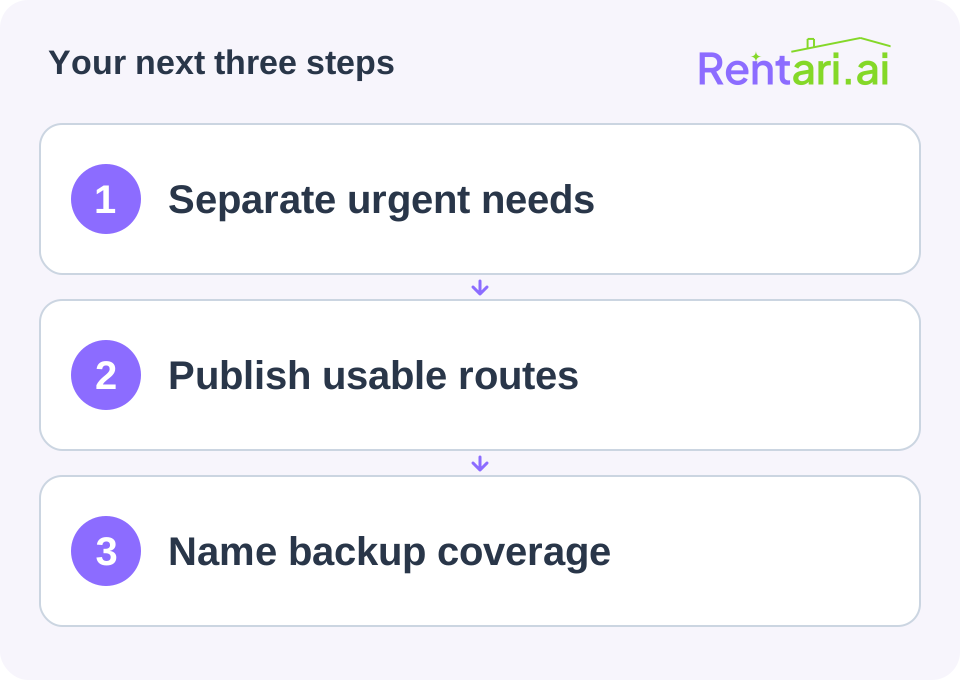
Define the categories plainly
Explain that immediate danger requires the appropriate emergency service. Provide the property's emergency contact for urgent property issues and a routine route for nonurgent repairs or account questions.
Use examples relevant to the property without pretending a short list can diagnose every emergency. Avoid promising round-the-clock response unless you actually provide it.
Make each route workable
List the contact method, expected handling, and alternative if the usual method fails. Provide an accessible option for residents who cannot use the portal.
Test contact details through a safe internal process. Confirm where messages go and who sees them during absences.
Assign responsibility
Name primary and backup coverage, handoff expectations, and how an unresolved report is escalated. Keep private staff information out of public materials unless intentionally approved.
Update the instructions after a provider, number, or staffing change. Make them available at move-in and in a location residents can find later.
The goal is a dependable route, not a collection of phone numbers. Review one recent report from arrival to response and identify any point where nobody clearly owned the next step.
Continue with a related task
Also online: Choose Clear Channels for Emergencies, Repairs, and Routine Questions
Chapter 2 How to respond to a rental repair request and follow it through
Move a repair from first report to verified work with clear urgency, access, communication and follow-up. Repair duties and deadlines depend on the location and circumstances; check the rules that apply before promising a fixed timeframe.
Protect people from immediate danger first
A fire, suspected gas leak, electrical hazard, serious injury or other immediate danger needs an emergency response, not a routine maintenance ticket. Follow the property's emergency instructions and contact emergency services or the relevant utility as appropriate. If gas may be escaping, leave without operating lights or electronics inside and contact help from a safe location.
Keep emergency contacts and after-hours instructions separate from the routine request process. A maintenance app, email queue or contractor search is not an emergency response service.
Prioritize the condition and its effects
Ask what is affected, whether the condition is active or getting worse, which rooms or services are involved, and whether people can use the home safely. Water intrusion, loss of an essential service, a failed lock, or a condition involving electricity may need a faster assessment than a cosmetic repair, but no category by itself sets a legal deadline. Weather, the extent of damage, the household's circumstances, local codes, the lease, and any housing program can change the required response.
Do not promise that every urgent item has a 24-hour deadline, that every other repair can wait 30 days, or that one state statute sets a universal completion time. Verify the actual rule and the facts for the property. If the condition affects habitability or immediate safety, promptly contact a qualified local housing professional or attorney while arranging the practical next step.
Choose safe interim steps for common failures
Use the actual hazard to choose the next step; these examples do not replace the property's emergency plan or local requirements:
- A breaker trips: Record what lost power and any smell, sound, heat, or visible damage. Do not tell a resident to keep resetting the breaker or handle wiring; arrange qualified electrical assessment. The Consumer Product Safety Commission advises investigating why a breaker trips rather than simply resetting it.
- Water is actively escaping: If a shutoff is clearly known and can be reached safely, it may help limit damage. Do not enter standing water or touch wet electrical equipment; Ready.gov warns against both hazards. Use the property's emergency contact and arrange a qualified response.
- Cooling fails during extreme heat: Check the current indoor conditions and whether anyone needs urgent help. The CDC identifies groups at higher risk and points people toward air-conditioned locations. Do not treat a routine vendor window as a safe plan when heat illness may be developing.
- Refrigeration is lost during a power outage: Keep refrigerator and freezer doors closed as much as possible and use FoodSafety.gov's item-by-item outage chart. Its four-hour refrigerator guidance applies to an unopened refrigerator during a power outage; do not assume it covers every appliance failure.
For any appliance, avoid diagnosing from a short description or giving a copied price range. Record the symptoms, arrange an appropriately qualified assessment, and share only interim steps that are safe for that home.
Record the report without guessing at a cause
Capture the property and unit, exact location, what the resident observes, when it started, whether it is ongoing, any immediate safety concern, and a reliable contact method. Ask for a photo only when it is safe and useful. Keep the resident's description separate from a later vendor diagnosis; a stain or sound may have several causes.
Use the notice channel and emergency process in the agreement. Save the received date, the original message, attachments, and any delivery or acknowledgment record. Do not require a particular app for emergencies or treat a missing photo as a reason to ignore a report.
Separate acknowledgment, attendance and completion
These are different points in the repair timeline: the request was received; someone acknowledged it; a visit was arranged; the professional attended; work was performed; and the result was checked. Record each date and the person responsible for the next action. A quick reply or a booked visit does not mean the repair is complete.
Tell the resident what is known, what is still uncertain, and when the next update will come. Avoid promising a completion date before the right person has assessed the work and confirmed parts, access, and schedule. An update target helps communication; it does not replace a required legal response.
Send an update with a real next step
Copy-ready structure: Thanks for reporting [condition] at [location]. Is it still active, and is anyone in immediate danger? Please do not [unsafe action]. I have [specific next step or professional] underway. I will update you by [date and time], even if the repair window is still unknown.
Use the appropriate emergency route first when someone may be in immediate danger. Set an update checkpoint you can keep; it is a communication target, not a repair deadline or a promise that work will be complete.
Arrange qualified work and lawful access
Describe the observed condition, requested assessment, access arrangements, estimate or spending approval, and how the worker should report new findings. Check that the professional is qualified for the actual job and verify licensing or permit requirements where they apply. Follow notice, entry, privacy, and accommodation rules; coordinate a suitable time and tell the resident who is expected to arrive.
Do not ask a resident to open walls, move gas equipment, touch wet electrical equipment, or perform work that belongs with a qualified professional. If the scope changes or the vendor cannot attend, update the resident and name the next responsible person.
Explain delays and keep following up
When a part, specialist, or access window is delayed, record the reason, what was checked, any appropriate temporary protection, and when the next update will occur. Temporary steps must be safe for that home and must not become a substitute for a required repair. A vendor backlog does not automatically remove the housing provider's obligations.
If the original estimate changes, document who approved the additional work. Keep the request active until the condition has been addressed or the next justified action is clear; ordering a part or sending a vendor does not verify the outcome.
Verify the result and keep an unresolved issue open
After work, record the vendor's findings, work performed, any test or inspection, remaining items, invoice, and the resident update. Check whether the reported symptom has stopped. If it continues or returns, add the new observation and arrange follow-up rather than closing the record because someone attended.
Keep repair costs, payment, and request status as related but separate records. A resolved ticket does not by itself establish that the whole system is safe, that an invoice was paid, or that every underlying cause was found.
Check local rights before choosing a remedy
A renter whose report remains unresolved can keep a dated copy, use the required written contact route, and ask a local housing or code-enforcement office, tenant organization, or qualified attorney which rules apply. Repair-and-deduct, rent withholding, escrow, lease termination, notice and complaint steps vary by jurisdiction and situation. Do not rely on a national day-count or take one of these steps without checking the exact local procedure.
Owners and authorized managers should review applicable habitability, notice, accessibility, anti-retaliation, and program duties before deciding how to respond. For official state agency contacts, start with USAGov's tenant-rights guide. This written guide is general information, not a decision about a particular repair or legal remedy.
Use software to organize the record
Rentari can help an owner or authorized manager keep a maintenance request, messages, assignments, status, work-order details, and related property records together. The user still assesses urgency, verifies local requirements, arranges qualified work, follows access rules, and confirms the outcome. Rentari does not provide a repair service, determine legal deadlines, or guarantee vendor response. See the maintenance triage and vendor handoff guide and the maintenance-board instructions.
Sources and further reading
Also online: How to respond to a rental repair request and follow it through
Chapter 3 Maintenance Intake and Work-Order Checklist
A repair intake form should gather enough information to route the issue safely. It should not turn the resident into a technician.
Work through the checklist
Use the download to keep your record.
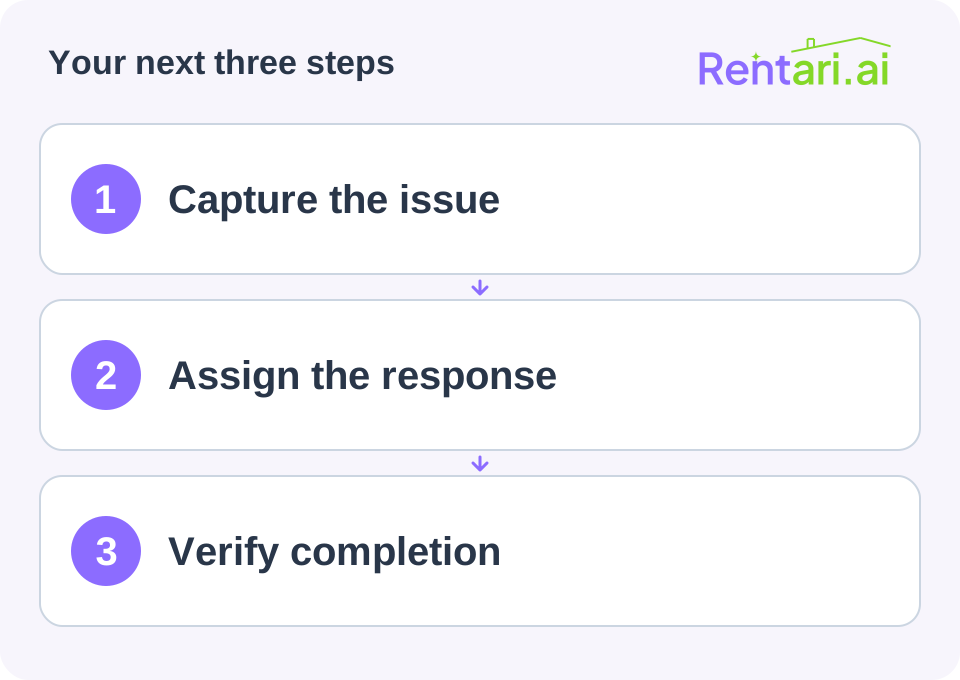
Capture the essentials
Record property and unit, room or fixture, reported symptom, start time, whether it is ongoing, and safe contact details. Ask whether there is immediate danger and direct emergencies to the appropriate emergency service and property contact.
Photos are optional when unsafe or impractical. Do not ask for dangerous access or contact with electrical equipment.
Set the response
Assign a responsible person, qualified vendor where needed, urgency, next update time, and lawful access plan. Record the approved scope and how additional work is authorized.
Keep diagnosis and cost responsibility open until the relevant evidence is reviewed. A resident's initial description is not proof of cause.
Close the loop
Record findings, work completed, remaining issues, invoice reference, warranty information, and the verification method. Update the resident in plain language and explain any follow-up.
Use separate fields for appointment booked, vendor attended, work completed, and issue verified resolved. Those events are not interchangeable.
Review aging open requests regularly. If the job is waiting on a part, name the person responsible for the next update instead of leaving the request indefinitely marked in progress.
Keep your completed record
Save the worksheet with the supporting records and restrict access to people who need it. This blank organizer does not calculate a legal, tax, insurance, or eligibility decision.
Continue with a related task
Also online: Maintenance Intake and Work-Order Checklist
Chapter 4 Respond to Noise Complaints with a Neutral Incident Record
A noise complaint needs specific information and a consistent response. Labels such as troublesome neighbor do not help establish what occurred.
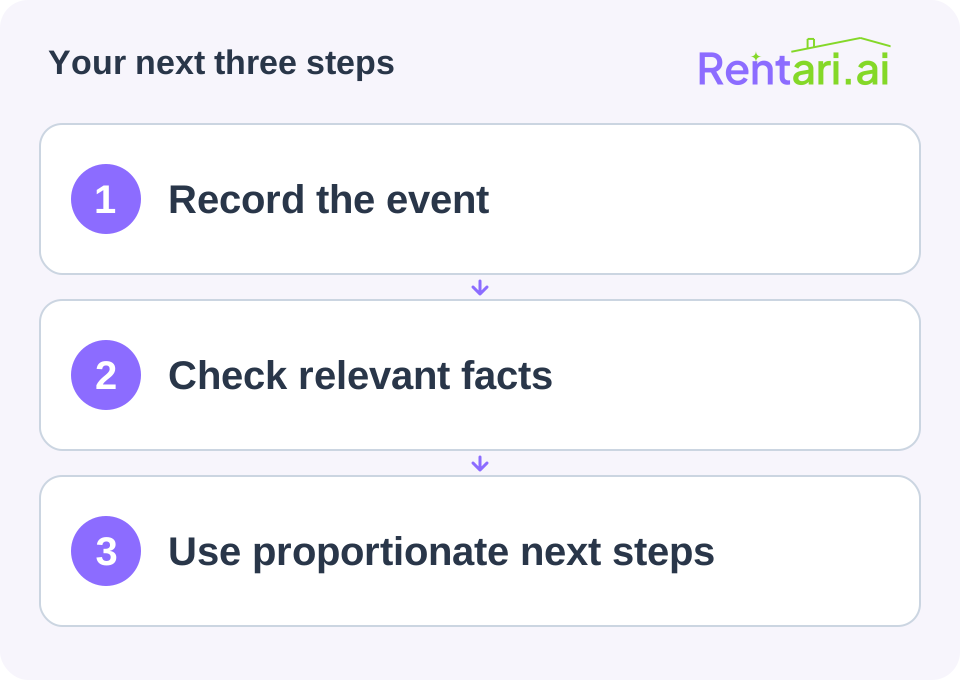
Ask for observable details
Record dates, times, location, duration, description, and how the complainant was affected. Distinguish an ongoing emergency from a routine concern. Immediate danger belongs with emergency services.
Do not encourage confrontation, trespass, or intrusive recording. Check applicable privacy and recording rules.
Review the context
Check relevant lease terms, building rules, local requirements, prior documented events, and any maintenance cause. A mechanical vibration and a social gathering may require different responses.
Speak neutrally with the appropriate parties without promising anonymity you cannot guarantee or disclosing unnecessary private information.
Document the next step
Record the factual response, any reviewed reminder, maintenance action, or qualified legal referral. Keep alleged and verified events distinguishable.
Use the required local process before enforcement or tenancy consequences. Do not make a decision based on stereotypes, diagnoses, or protected characteristics.
After the action, check whether the reported condition recurred. The useful outcome is a clear event history and a proportionate response, not a growing file of unsupported character assessments.
Continue with a related task
Also online: Respond to Noise Complaints with a Neutral Incident Record
Chapter 5 A Factual Rent Reminder and Balance-Review Checklist
Use this routine reminder only after checking the ledger. It is not a notice to pay, terminate, or vacate, and does not replace jurisdiction-specific forms or service requirements.
Work through the checklist
Use the download to keep your record.
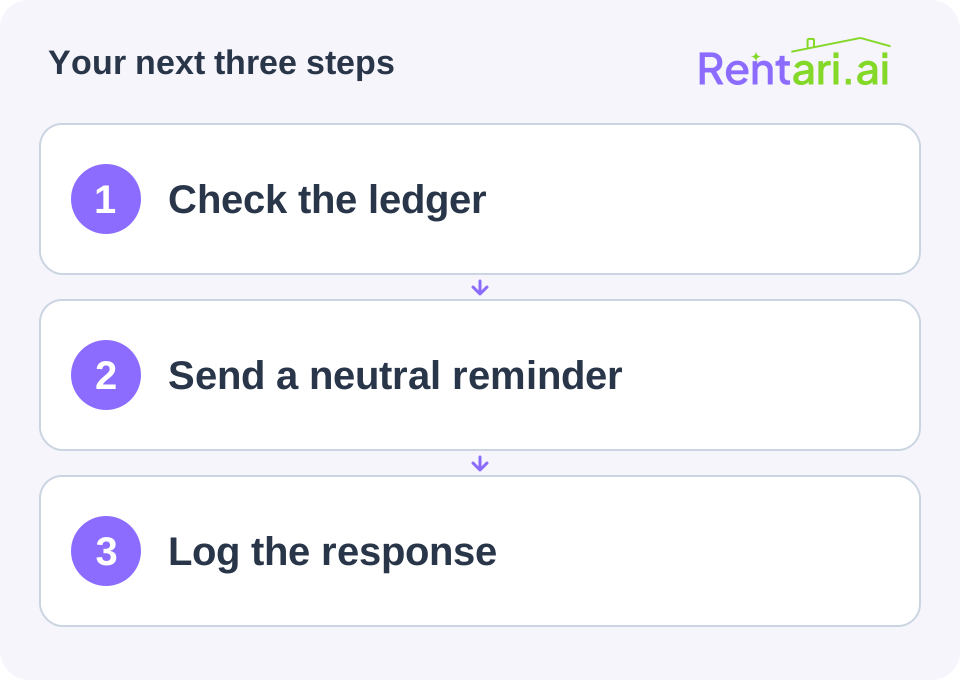
Verify before sending
Confirm the account, period, charges, payments, credits, returns, and as-of date. Review any pending transaction and documented payment arrangement. Check whether the resident has already reported a missing payment.
Do not insert a fee unless its basis, amount, and timing have been reviewed.
Use clear wording
Our records show [amount] outstanding for [period] as of [date]. The account summary is [secure link or attachment]. If a payment or adjustment is missing, please send its reference through [secure channel] so we can investigate. Please contact [team] about the next step.
Use the actual balance and a secure, usable route. Do not threaten consequences you have not reviewed or imply that a processing transaction never occurred.
Record the outcome
Log the date, recipient, response, disputed item, and follow-up owner. A promise to pay is a communication event; it is not a receipt. Update the ledger only when the underlying transaction or approved adjustment occurs.
If the matter requires legal escalation, use the appropriate local workflow separately. Consistent reminders and accurate records make that review clearer.
Use a different message before rent is due
Agree the routine at move-in: due date, permitted methods, contact channel and where a resident can question the amount. A before-due message should not label rent overdue or add an unreviewed fee. Use the existing balance checks first and coordinate any scheduled reminder with recent payments or a documented arrangement.
Rent for [period] is due on [date] under your agreement. Please review the amount and accepted methods at [verified payment path]. If you have already started payment or need an account correction, contact [team] through [secure reply path] with the reference.
This original message is a routine reminder, not a statutory demand. Keep sensitive account details out of shared channels. Use the after-due example above only when its reviewed facts apply.
Choose a usable channel and check the actual result
Confirm current contact details and the resident's communication needs. Use a channel they can access instead of repeating the same message across every available channel. Coordinate manual and scheduled messages so an unresolved transaction or reply does not trigger contradictory demands.
Where applicable, review disability-related communication requests promptly. HUD and DOJ guidance explains that accommodation requests may be oral, need no special wording and require appropriate consideration. Consistent policies still need lawful accommodation review; do not interpret consistency as a ban on every exception or waiver.
Follow Rentari's rent-activity guide and use Send reminder when available for the correct charge. Review the recorded result or error. A queued or sent message is not evidence that the resident read it or that formal service occurred. If collection rules may apply, CFPB guidance distinguishes covered debt collectors from original creditors and notes additional state protections. Obtain qualified advice about contact restrictions or required notices rather than relying on a software label.
Keep your completed record
Save the worksheet with the supporting records and restrict access to people who need it. This blank organizer does not calculate a legal, tax, insurance, or eligibility decision.
Common questions
Can I send a reminder before the due date?
Use the agreed routine and accurate date, amount and accepted methods. Check recent payments and arrangements first. Do not describe rent as overdue or insert a fee before its lawful basis and timing have been reviewed.
Does a sent reminder prove formal notice was served?
No. A routine reminder, queued notification, actual delivery and statutory service are separate. Use the current local notice and service process when formal action is required.
Must every resident receive identical reminder formats?
Use consistent, lawful policies while reviewing accessibility and applicable accommodation needs. A disability-related request may be oral and needs appropriate consideration; identical delivery formats do not automatically satisfy that duty.
Sources and further reading
Source review: October 12, 2026. Check current requirements before acting.
Continue with a related task
Also online: A Factual Rent Reminder and Balance-Review Checklist
Chapter 6 Resolving landlord-tenant disputes: talk, document, mediate, then court
Many landlord-tenant disagreements can be settled with a direct conversation backed by good records. When talking fails, mediation and small claims court are the next options, and some states build mediation into the process. Throughout, avoid anything that looks like retaliation.
Start with a conversation
Whether the issue is money, repairs or move-out, start the same way before you escalate:
- Name the issue in one sentence and check what the lease says about it.
- Listen to the other side's version and ask what outcome they want.
- Offer a specific fix with a date, such as a repair visit or a payment plan.
- Follow up in writing with what you agreed.
Keep a written record
If the dispute goes further, the side with clear records is easier to believe. Keep:
- The lease, addenda and any notices, with how and when each was delivered.
- The rent ledger and payment receipts.
- Move-in and move-out condition reports and dated photos.
- Repair requests, work orders and completion notes.
- Messages, plus a short written summary after any phone call or visit.
Try mediation
In mediation, a neutral person helps both sides reach their own agreement. Some states require or encourage it at certain points:
- Hawaii: a landlord's notice for unpaid rent must also go to a state-funded mediation center that offers free landlord-tenant mediation. If the tenant schedules mediation, the landlord must take part (HRS § 521-68(a), (c)).
- Maine: the court may refer the parties in an eviction case to mediation at any time, and a mediated agreement must be written, signed and approved by the court (14 M.R.S. § 6004-A). The court offers day-of-hearing mediation without an additional charge (Maine Judicial Branch: residential nonpayment guide).
- Kansas: from July 1, 2026, the court must consider mediation in an eviction case unless it finds mediation would not materially help or is impracticable (K.S.A. 61-3806(c)).
- New Hampshire: small claims over $5,000 heard without a jury go to mediation first (RSA 503:1, IV).
Elsewhere, check your court's website or ask the clerk whether a mediation program is available.
Small claims court for money disputes
Small claims courts hear money claims, such as unpaid rent after move-out or a disputed deposit, with simpler procedures. Limits vary:
- California: up to $6,250, or $12,500 when the person suing is a natural person (Cal. Code Civ. Proc. § 116.220(a)(1)) (Cal. Code Civ. Proc. § 116.221).
- Texas: justice courts hear civil claims up to $20,000, not counting interest (Tex. Gov't Code § 27.031), under rules that may not require a party to have a lawyer (Tex. Gov't Code § 27.060).
- New York: up to $10,000 in New York City Civil Court, $5,000 in city courts outside the city and in district courts, and $3,000 in town and village courts (N.Y.C. Civ. Ct. Act § 1801) (N.Y. Uniform City Ct. Act § 1801) (N.Y. Uniform Just. Ct. Act § 1801).
- Maine: up to $10,000 since January 1, 2026, not counting interest and costs (14 M.R.S. § 7482).
In some states an eviction is a separate kind of case. Maine and New Hampshire, for example, handle possession outside small claims.
Stay clear of retaliation
Many states bar landlords from punishing renters for exercising their rights, and the protected period can be long:
- California: for 180 days after a tenant in good faith requests repairs or complains to you or a government agency about habitability, you may not recover possession, raise the rent or cut services because of it (Cal. Civ. Code § 1942.5(a)).
- Texas: for six months after a tenant in good faith uses a legal remedy, gives a repair notice or complains to a code agency, retaliation such as filing an eviction or raising the rent is barred (Tex. Prop. Code § 92.331).
- New York: refusing to renew, or offering a renewal at an unreasonable increase, after a good faith complaint can count as retaliation (N.Y. Real Prop. Law § 223-b).
Never try to settle a dispute by changing locks or cutting utilities. California, for example, bars doing either with intent to force a tenant out (Cal. Civ. Code § 789.3(a), (b)).
When to get legal help
Talk with a lawyer, or a legal aid office if you qualify, before you file or answer an eviction, when a dispute involves a discrimination claim or an injury, or when a large sum is at stake. Check your state court's website for self-help guides, such as the Maine Judicial Branch eviction guide.
This guide is general information, not legal advice. Rules change and vary by state and city, so confirm how they apply to your situation with a local attorney.
How Rentari helps
Messaging with renters, maintenance requests, payment receipts and lease documents stored on the lease give you a dated record of what was said, asked and paid. Rentari keeps the record; it does not file anything with a court or give legal advice.
Sources and further reading
- Hawaii Revised Statutes 521-68: notice for nonpayment and mediation
- Maine Revised Statutes title 14, 6004-A: mediation in eviction cases
- Maine Judicial Branch: evicting a tenant for nonpayment
- Kansas Statutes 61-3806
- New Hampshire RSA 503:1: small claims
- California Code of Civil Procedure 116.220: small claims jurisdiction
- California Civil Code 1942.5: retaliation
Also online: Resolving landlord-tenant disputes: talk, document, mediate, then court
Chapter 7 Holdover tenants: what to do when a renter stays after the lease ends
A renter who stays past the end of the lease is usually still a tenant in the eyes of the law. What you do in the first few days, especially whether you accept rent, shapes your options. Recover the home through notice and court, never by changing the locks.
What makes a renter a holdover tenant
A holdover tenant is a renter who stays in the home after the lease term or a valid notice period has ended, without a new agreement. The renter moved in lawfully, so most states treat them as a tenant rather than a trespasser. That means the ordinary notice and eviction rules still apply.
There are two very different situations. In the first, you agree, even informally, that the renter may stay. In the second, you want the home back and the renter has not left. Your state's rules treat these differently, so decide which one you are in before you reply to the renter or deposit another payment.
Your first decision: consent or not
Accepting rent for a period after the lease ends can be read as consent to a new tenancy. In South Carolina, for example, a tenant who stays with your consent continues month to month (S.C. Code Ann. § 27-40-770(c)). In Florida, a tenant who stays with your permission but without giving the month-to-month notice owes an extra month's rent (Fla. Stat. § 83.57).
- If you agree to a short stay, put it in writing: the new end date, the rent for the extra period and whether the other lease terms continue.
- If you do not agree, tell the renter in writing that you are not renewing and want possession, and check your state's rules before accepting any further payment.
Never use self-help
Changing the locks, removing doors, taking the renter's belongings or shutting off utilities to force someone out is illegal in most states, even after the lease has ended. California, for instance, bars cutting off utilities, changing locks or removing belongings with intent to force a tenant out (Cal. Civ. Code § 789.3). Penalties can include damages owed to the renter. Every Rentari state law page lists that state's lockout and utility rules.
How to recover the home
The usual path is a written notice to vacate, followed by an eviction case if the renter still does not leave. The notice period, delivery method and wording vary by state. In Texas, a landlord evicting a renter who holds over must give the notice to vacate the eviction statute requires before filing (Tex. Prop. Code § 24.005). In Mississippi, after a fixed-term agreement expires, you may notify the renter that they are holding over and start proceedings no earlier than three days after the notice (Miss. Code Ann. § 89-8-17(2)).
Keep copies of the lease, the end date, every notice and how it was delivered, and any messages about move-out. A court will want to see when the tenancy ended and how the renter was told.
What you may be able to recover
A renter who stays usually owes rent, or its value, for the time they remain. Some states allow more when the stay is without your consent:
- Florida: double rent for the holdover period when the tenant stays without permission (Fla. Stat. § 83.57).
- Mississippi: double rent for the time after the move-out date in your notice, unless the rental agreement says otherwise (Miss. Code Ann. § 89-8-19(1)).
- South Carolina: for a wilful holdover, up to three months' rent or twice your actual damages, whichever is greater, plus attorney's fees when the holdover is not in good faith (S.C. Code Ann. § 27-40-770(c)).
Other states have their own rules, and some have none beyond ordinary rent and damages. Check your state before you demand an amount.
How to prevent a holdover
- Start early. Confirm renewal or move-out well before the lease ends, in writing.
- Agree on a date. When a renter needs a few extra weeks, a short written extension with a firm end date avoids an open-ended stay.
- Plan the move-out. Share the move-out checklist, key return and forwarding address request ahead of time.
- Know your next tenant's date. Leave a buffer between leases so one late move-out does not cascade.
How Rentari helps
In Rentari, each lease shows its end date, and you choose a renewal or a move-out plan from the lease. Renters can review a renewal offer or record their move-out notice and forwarding address in their portal, and messages and notices stay on the lease record. Rentari keeps the record; it does not file an eviction or decide what your state allows.
Also online: Holdover tenants: what to do when a renter stays after the lease ends